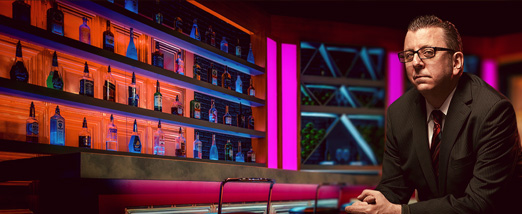
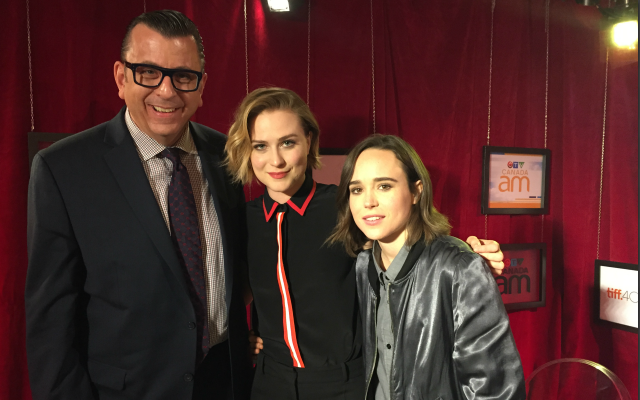
Richard will host a Q&A with “Into the Forest” stars Elliot Page and director Patricia Rozema at the Varsity Theatre on Tuesday May 31, 2016 at 7 pm. Later in the week keep your eye on “Canada AM” to see Richard’s sit down interview with Page and co-star Evan Rachel Wood!
Alice Through The Looking Glass, the six-years-in-the-making sequel to Tim Burton’s Alice in Wonderland, takes place in a world where chess pieces come to life and the Cheshire Cat’s grin is as toothy as ever. It’s a flight of fantasy, based on a story published by Lewis Carroll in 1871, but grounded by the very human character of Alice Kingsley.
Mia Wasikowska has played Alice since the 2010 film, signing on to the first movie when she was just 18 years old.
“There is always a little bit of trepidation especially when you’re dealing with a character who is so iconic and so beloved by so many people and so many generations,” she told me on the release of the first film.
“But there is also a certain amount of realism to it because you know you can’t please everyone and not everyone is going to be pleased so it is more just making the character your own and feeling comfortable in the decisions you make.”
Originally imagined by Carroll in 1865, the little girl who found a world of wonder down the rabbit hole has become one of literature and film’s more enduring and malleable characters.
She was the insane character of America McGee’s video game Alice and the martial arts instructor of a Syfy channel adaptation. In 2010 Wasikowska said she thinks the stories have lasted because people relate to the strange characters and situations.
“I don’t believe in normal,” she said. “Nobody is normal. Everyone is crazy in his or her own way. So although these are extreme characters I think that just makes them more identifiable.
People want to see these characters, understand these characters, love these characters, feel comfortable with these characters because they are like everybody in this world who are kind of crazy. Everyone has felt like an outsider at some time in their life so it is a very identifiable story.”
Alice first got the big screen treatment in 1903 in a 12-minute silent version starring Mabel Clark, who was also employed on the set as a “help-out girl,” making costumes and running errands.
In 1966 director Jonathan Miller cast Anne-Marie Mallik as the lead in Alice, a mad-as-a-hatter made-for-BBC movie. Miller called Mallik, who auditioned by reciting a poem, a “rather extraordinary, solemn child.”
Not everyone agreed. Peter Cook’s biographer described the teenager’s take on Alice as “sullen, pouting, pubescent with no sense of bewilderment.” Mallik later said she wasn’t impressed with her illustrious co-stars — John Gielgud as the Mock Turtle and Peter Sellers as the King of Hearts — because she had grown up surrounded by the very accomplished friends of her “much older” parents.
After production wrapped she “retired” from acting and afterward the BBC had trouble paying her a royalty because they couldn’t find her.
It’s hard to know what Alice Liddell, the young girl who inspired the character would have thought of any of the wild and wacky versions of the story, but we do know she enjoyed the 1933 Paramount version.
“I am delighted with the film and am now convinced that only through the medium of the talking picture art could this delicious fantasy be faithfully interpreted,” she told the New York Times. “Alice is a picture which represents a revolution in cinema history!”
Whit Stillman has made just five films since his 1990 debut Metropolitan, but those movies, despite being set in various countries and time periods, are remarkably consistent in theme. Fascinated by privilege, he has chronicled the lives of young, beautiful rich people in art house movies like “Barcelona,” “The Last Days of Disco” and “Damsels in Distress.”
His latest film, “Love & Friendship,” fits snugly beside the others. Based on the Jane Austen novella “Lady Susan” it is places the action in the 1790s, but the subversive glimpse at upper class society is pure Stillman.
Kate Beckinsale is Lady Susan Vernon, a broke, recently widowed aristocrat whose scandalous behaviour in London has whittled down opportunities for social advancement for her and her daughter Federica (Morfydd Clark). “We don’t live,” she says, “we visit, entirely at the convenience of our relatives.” An acid-tongued schemer, Lady Susan survives on the kindness of her former sister-in-law Catherine Vernon (Emma Greenwell). Opening the doors of her country estate to Susan only exposes the hostess to the widow’s Machiavellian dealings, the attempted seduction of Catherine’s brother Reginald de Courcy (Xavier Samuel) and a plan to marry off Frederica to the wealthy but di-witted Sir James Martin (Tom Bennett).
“Love & Friendship” is a comedy of manipulation and ill-manners that must be the funniest Austen adaptation since “Clueless.” Stillman regular Beckinsale (she appeared in “Last Days of Disco”) is letter perfect as the seductively icy, pennilessly haughty Lady Susan, “the most accomplished flirt in England.” Rattling off the breezy dialogue with ease, she’s an anti-heroine who at one point admonishes a man for approaching her on the street, threatening to have him whipped if he says another word. “I know him well,” she says to her American confidante Alicia (Chloe Sevigny, another “The Last Days of Disco” alum), “I would never speak to a stranger like that.” She’s fantastically unrepentant, a paragon of self-absorption who looks down on everyone.
A uniformly strong cast—including the scene stealing Tom Bennett whop hands in one of the great comedic performances of the year—help Stillman bring the world to life. The set decoration and costuming is very “Masterpiece Theatre,” but the feeling of the piece is very modern.
“Hope for the best,” says Hank McCoy a.k.a. Beast (Nicholas Hoult) midway through “X-Men: Apocalypse,“ “but prepare for the worst.”
That’s the way I approach the X-Men movies. When a movie series spans a universe of stories—in addition to five X-Men flicks, this is the third “First Class” movie—caution is advised. The general rule of thumb is one of diminishing returns: the further away from the source, the weaker the story.
“Apocalypse” isn’t exactly the best of the X-Men movies, but it’s hardly the worst either. What it lacks in surprises, it makes up for in bombast.
“A gift can often be a curse,” we’re told in the opening narration. “Give them the greatest gift of all, power beyond imagination and they think they should rule the world.” Such is the case with En Sabah Nur (Oscar Isaac) an immortal Egyptian pharaoh betrayed a millennium or two ago, left in a fitful slumber under the rubble of a collapsed pyramid.
Cut to the early 1980s. Series regulars Magneto (Michael Fassbender), Nightcrawler (Kodi Smit-McPhee), Angel (Ben Hardy) and Mystique (Jennifer Lawrence) are going about life as usual… or as usual as they can while shape shifting and instantly transporting from place to place.
Their lives intersect again when En Sabah Nur, now nicknamed Apocalypse (no foreshadowing there) emerges from his sleep, eager to take his place as king of the world. The mutant god absorbs television news to learn about the modern world before assembling his disciples—his four horsemen—and unlocking the one last power he needs to control the planet. With the world’s fate resting in his hands Professor X (James McAvoy) brings a team of X-Men to do battle.
The first X-Men movies were allegories for all manner of twentieth century intolerance but gradually over time the civil rights elements of the story have become more lip service than social comment. “Apocalypse” distances itself even further from the core of what made the originals interesting, leaving behind a serviceable action movie that plays more like a Successories unleash-your-power platitude than a cry for universal liberties.
Instead we are given a villain who melodramatically says things like, “Come! Rescue your weakling!” and a CGI climax that feels lifted from “Batman v. Superman” or “Age of Ultron.” The dumbed down story of friendship and teamwork may not engage the brain but it does, however, have outlandish visuals to dazzle the eye. A show stopping Quicksilver (Evan Peters) scene has the faster-than-light mutant rescue a dozen people from a bombed out building, frozen in time by his supersonic speed. It’s cool and like the movie’s best images has the verve and invention the script lacks.
When the film’s biggest reveal is James McAvoy’s bald Professor X head you know the movie is light on new ideas but “X-Men: Apocalypse“ transcends the law of diminishing rewards by upping the action.
“Alice Through The Looking Glass,” the six years in the making sequel to Tim Burton’s $1 billion grossing “Alice in Wonderland,” takes place in a world where butterflies speak and the Red Queen applies her lipstick in a heart-shaped motif, but what should be a flight of fancy is grounded by a dull story.
The topsy-turvy world of Underland is more or less intact since the last time Alice Kingsleigh (Mia Wasikowska) visited. Chess pieces still come to life, Tweedledee and Tweedledumb (Matt Lucas) continue to speak in rhyme and the Cheshire Cat’s (Stephen Fry) grin is as toothy as it ever was.
One thing is different, however. The Mad Hatter (Johnny Depp), Alice’s greatest friend and ally in the otherworld, is having some problems. Call him the Sad Hatter. “He’s just not the same anymore.” Thinking of his family’s demise courtesy of the fiery breath of the Jabberwocky has thrown him into a depression. To help the Mad Hatter out of his funk Alice steals a time travel device from Time (Sacha Baron Cohen) himself (“I am time,” he says, “the infinite, the immortal, the measurable… unless you have a clock.”) ignores warnings about changing the past and careens across the ocean of time to find out what happened to Hatter’s folks. “Do try not to break the past, present or future,” purrs the Cheshire Cat.
“Looking Glass” is an epic fantasy artfully directed by James Bobin but lacking the effortlessly odd feel of Tim Burton’s work on the first film. It’s a trippy story that transverses time and space and should invite the viewer to turn on, tune in and drop out but the true weirdness of the story, the unhinged voyages of imagination, are absent. Instead we’re thrown into a world that feels like we’ve seen it all before: familiar and not nearly whimsical enough. It’s a sea of CGI with a story cut adrift inside it.
It’s lovely to hear Alan Rickman’s voice, if only briefly, as Absolem the Caterpillar on screen again and Baron Cohen does his best to breath life into his character, but no one, not even the Mad Hatter—who should more rightly be called the Quirky Hatter—is interesting enough to merit the movie’s hour-and-forty minute running time. There is a high level of craft evident in the computer-generated images, the costumes and set decoration, everywhere, in fact, except the story that seems to value “time” puns over actual plot.
Perhaps in six years or so, if they decide to add another film to this franchise, they’ll take heed of a bit of “Looking Glass’s” theme about learning something from the past and give the next movie the excitement and story Lewis Carroll’s creation deserves.
“Mr. Right” is a rom crime com that plays a bit like “Pitch Perfect” with a very high body count.
Anna Kendrick is Martha, a twenty-something who dumps her boyfriend when he cheats on her. The morning after a wild bender—”I want to do something terrible,” she says.—she it’s love-at-first-sight with a stranger (Sam Rockwell) she meets at a supermarket. He’s a babyface assassin who cold bloodedly murders for money. “Killing is wrong,” he says, “but I’m not perfect.” Part Bruce Lee, part James Bond, he’s as lethal as he is charming. Ignoring the obvious warning signs—he won’t tell her his name and jokes about killing people—she falls for him and is only slightly conflicted on their third day together when she sees him shoot a man. “Are you upset that I killed that guy?” he says. “How I feel about that guy has nothing to do with how I feel about you.” They flirt, banter back and forth and after some metaphysical weapons training are a committed couple. “When I was little I had a dream I was dating Lex Luther,” she coos. Now if only the squads of hitmen sent to kill him would lay off, the couple could decide whether she is his weakness or the Bonnie to his Clyde or both.
Other movies have trod this path. “Something Wild,” “Grosse Pointe Blank” and “True Romance” all mix affection with offing, and all do it better than “Mr. Right.” What this movie has going for it is a handful of clever lines—for instance, Rockwell’s dusty charm is described as “fancy homeless”—and two people who know how to deliver them, Kendrick and Rockwell. Despite a seventeen-year age gap, or maybe because of it, they click.
The first half of the movie, before it turns into a shoot ‘em up, has many funny, charming moments. The preposterousness of the story aside, there are enough effervescent screwball moments in Max Landis’s screenplay to carry the day. But just about the time bad guy Johnny Moon (Michael Eklund) says, “Don’t let this become unfun… This is supposed to be fun,” it’s hard not to disagree with him. What was once a light and fluffy—if a little bloody—confection loses its way in a hail of bullets and beatings.
“Mr. Right” doesn’t get everything right, but in between the quirky trying-too-hard moments are some amiably charming moments.
“A Tour De Force,” Richard’s look at the history of “Star Wars” has been nominated for a RTDNA Award in the category of Dave Rogers Award – Long Feature – Radio.
RTDNA Canada, The Association of Electronic Journalists, is pleased to recognize excellence in electronic journalism for the Network stations. Read more HERE! Listen to the Tour De Force series HERE!
How to describe High-Rise, the darkly funny film from director Ben Wheatley?
Here goes; imagine the love child of Lord of the Flies and The Towering Inferno. An adaptation of J.G. Ballard’s novel about class segregation in a luxury condo, High-Rise is chaotic and completely bonkers.
“There’s material in here that is difficult and there’s structure in here that’s difficult but there’s also fun,” says Wheatley.
“There’s anarchy and sex and dancing and music. I always like to think about it like those 40s and 50s Hollywood movies and what they used to look like. There’d be no contradiction in a cowboy movie stopping for someone to sing a song.
“You don’t think about the pacing being really odd. The idea behind it was that those films were broken up into chunks. There’s a variety to them that make them really enjoyable. That’s what I was hoping for with this.”
Wheatley says the story of social warfare in the closed environment of an apartment building is just as relevant now as it was when Ballard wrote it in 1975.
“Ballard used to describe it that he was standing by the side of the road waving that there is danger ahead. But when I reread it when I was 40, it’s like, Crap, it’s not a warning anymore. It’s like it was taken from the newspaper. This is actually happening, which is kind of shocking but also kind of interesting.”
Known for his uncompromising films like Kill List and Sightseers, movies that critic Sheila O’Malley described as “black comedy thrillers involving crime, murder” and notable for their “absence of a moral compass,” the 44-year-old director is the cinematic spawn of mavericks like Nicolas Roeg, Ken Russell and John Boorman, British filmmakers who broke taboos in big budget movies like Don’t Look Now, The Devils and Deliverance.
“That was the mainstream,” he says. “When you dig into the BFI archive and look at the Jack Bond stuff and see the other end of the avant guard cinema that was being made at the same time, it was absolutely crazy. It’s a real shame that has been lost. What also makes me chuckle is you see reviews saying that High-Rise is insane or incredibly experimental and you think, ‘This film wouldn’t have stood out as all that strange in the ’70s.’ It would have been a more conservative film of that period.”
Today it’s a little tougher to raise money to get challenging films like High-Rise made. He says Hollywood-y or famous actors help, and to that end he signed Tom Hiddleston, Jeremy Irons and Mad Men’s Elisabeth Moss to tell his outlandish tale.
“I like what (producer) Jeremy Thomas says about it. His whole career has been about smuggling weird into the mainstream and I think that’s about right. It’s a deal between you and the audience.”
Part of that audience is Ballard’s considerable fan base.
“The Ballardian website have interviewed us a few times and they seem to be convinced that we haven’t totally pissed up the leg of the memory of J.G. Ballard. There was never any intention to rile those people. They are partly the reason we are able to do the film, they are the fan base. Why would you go out of your way to irritate people like that?”
Are you among the 200 million people that play Angry Birds on your smartphone? If so you’re in good company.
Angelina Jolie, Jack Black and Jon Hamm are fans and British Prime Minister David Cameron has admitted to being “mildly addicted” to the game. Since December 2009, folks have been flinging flocks of birds at pig’s fortresses, downloading more than 3 billion versions of the app.
This weekend the Angry Birds game takes the next logical step, catapulting onto the big screen with their very own movie.
Jason Sudeikis, Josh Gad and Maya Rudolph star in The Angry Birds Movie, a story that tells us why the annoyed avians — like flock leader Red Bird, Bomb the Black Bird and Slingshot Stella the Cockatoo — are so angry. Turns out they feel betrayed by the tittering piggies that pretend to be their friends but are really only interested in stealing their eggs. Cue the catapults and mountains of TNT.
It’s a brand with a built-in audience, a combination Hollywood finds irresistible, and while it has colourful, easily marketed characters, the game itself doesn’t offer much in the way of story. But that has never stopped producers before.
Remember Super Mario Bros? Siskel & Ebert gave that one two thumbs down and star Bob Hoskins, who played Mario, called it “the worst thing I ever did.”
Despite brutal reviews and box office failure, Nintendo Power magazine praised the film, calling it a trailblazer in the genre of videogame movies.
Which leads us, 23 years after Mario and his brother Luigi stunk up movie theatres, to The Angry Birds Movie. Why is a game from a developer in Espoo, just outside Helsinki, Finland, popular enough to take flight as its own movie?
The success of Angry Birds has to do with something called schema formation, a five-dollar term for mentally grasping and embedding how the game’s interface works the first time you play it.
The addictive part comes in as the action of the game changes. In Play at Work, engineer Charles L. Mauro explains the appeal: “These little birds are packed with clever behaviours that expand the user’s mental model at just the point when game-level complexity is increased.”
The game’s genius is in adding playing details at just the right moment to increase user engagement. In other words, it’s fun. I guess that’s why gamers spend 200 million minutes a day flinging Angry Birds at various targets.
According to marketers AYTM, that’s “equal to 16 years of gameplay every hour of every day.” They also note that players have flung over 100 billion angry birds, a number equal to the amount of real birds on the planet. Those are the kind of statistics Hollywood can’t ignore.
One person unlikely to pass the time with Angry Birds is U.S. communications surveillance whistleblower Edward Snowden. In 2014 he claimed the app was “leaky,” and was vulnerable to the harvesting of information by outside groups.
Mikael Hed, CEO of Rovio Entertainment, the makers of Angry Birds, denied Snowden’s claims.
“We do not collaborate, collude, or share data with spy agencies anywhere in the world,” he said, which must have come as a relief to another of the game’s biggest fans, former Vice President of the United States Dick Cheney, who, apparently, also enjoys hurling a bird or two in his spare time.
 Richard will host a Q&A with “Into the Forest” stars Elliot Page and director Patricia Rozema at the Varsity Theatre on Tuesday May 31, 2016 at 7 pm. Later in the week keep your eye on “Canada AM” to see Richard’s sit down interview with Page and co-star Evan Rachel Wood!