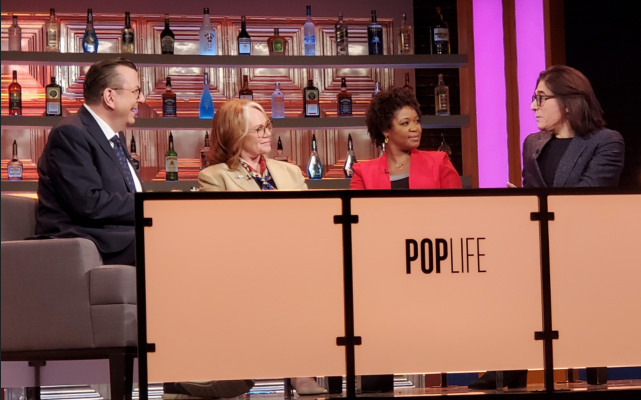
The tenth episode of season five of “Pop Life,” features an in-depth interview with Arlene Dickinson, Canadian businesswoman, investor, television personality and author of “Reinvention: Changing Your Life, Your Career, Your Future.” She stops by the “Pop Life” bar to discuss her new book, and how to make meaningful changes in your life at any age. Then she joins the “Pop Life” panel, musician Jason Sniderman (a.k.a. Ensign Broderick) and YouTube Influencer Jillian Danford to discuss life’s only constant–change.
Film critic and pop culture historian Richard Crouse shares a toast with celebrity guests and entertainment pundits every week on CTV News Channel’s exciting talk show POP LIFE.
Featuring in-depth discussion and debate on pop culture and modern life, POP LIFE features sit-down interviews with celebrities from across the entertainment world, including rock legends Sting and Meat Loaf, musicians Josh Groban and Sarah Brightman, comedian Ken Jeong, writer Fran Lebowitz, superstar jazz musician Diana Krall, stand-up comedian and CNN host W. Kamau Bell, actors Danny DeVito and Jay Baruchel, celebrity chefs Bobby Flay and Nigella Lawson, and many more.
In 2017 Kenneth Branagh delivered a new version of Agatha Christie’s “Murder on the Orient Express” that was as big and bloated as a new crime dramedy, “Knives Out,” is sleek and entertaining. Both feature large ensemble casts and twists galore but director Rian Johnson manages to breathe life into the creaky whodunnit genre.
The action takes place in a small up-state New York town on an estate one character says resembles a “Clue” board. In the film’s opening minutes the dramatic theme song sets the stage for what’s to come… murder most foul.
Marta (Ana de Armas), caregiver to Harlan Thrombrey (Christopher Plummer), the best-selling mystery writer of all time, is shocked to discover his dead body in his office. Throat slit, knife on the floor beside him, the local police Det. Elliot (Lakeith Stanfield) and Trooper Wagner (Noah Segan) think it is a suicide but a private investigator, the silver-tongued Benoit Blanc (Daniel Craig), disagrees and says so in an accent as thick as gumbo. “Ladies and gentlemen,” he says to the family, “I would like to request that you all stay until the investigation is completed.”
The assembled family stick around, partially at Blanc’s request but mostly for the reading of the will. “What will that be like?” asks Marta. “Think of a community theatre production of the reading of a tax form,” replies Blanc.
As the investigation unfolds everyone seems to have a motive for killing the old man, from his children the imperious Linda (Jamie Lee Curtis) and the hair-trigger tempered Walt (Michael Shannon) to various others, including the spoiled-rotten grandson Ransom (Chris Evans), devious son-in-law Richard (Don Johnson) and alt-right troll grandson Jacob (Jaeden Martell). These are people who believe they deserve to be rich and won’t hear any talk to the contrary.
The mystery has more layers than a Vidalia onion but Blanc unpeels it, one tier at a time leading up to the film’s climatic reveal.
“Knives Out” mixes pointed jabs at the 1%–Linda started her company with a modest one-million-dollar loan from her father—with social commentary about class divisions in American life to form the backdrop of this engaging mystery. Add to that a collection of characters that would make Miss Marple suspicious and the game is afoot.
Leading the charge is Craig. As Benoit Blanc, the American Poirot, he rides the line between ridiculous and shrewd, chewing the scenery with an accent unheard since the days of Colonel Sanders television ads. His flowery language—”Physical evidence can tell a story with a forked tongue,” he says—gives Craig a chance to show off his comedic side mixed with a physicality that suggests he can get the job done if need be. It’s a dramatic (maybe that’s not the word but you see what I mean) and welcome shift from his grim-faced 007 role.
What begins as a melodramatic comedy in the vein of “Murder by Death,” gets a little darker as the true nature of the crime is presented, and then funnier again in its wild ‘n woolly resolution. It’s an old-fashioned set-up but slowly echoes of modern-day issues of immigration, deportation and white entitlement are introduced to add edge to the story.
Director Johnson, he of “Looper” and “Star Wars: The Last Jedi,” is having fun here, finding a perfect rhythm in the unveiling of the story’s details. We always learn just enough to carry us through to the next twist and it is an enjoyable ride.
“The Two Popes” is an odd couple buddy picture about a friendship that proves that sometimes opposites attract.
The fact-based story (i.e. Based on a true story) begins in 2005 with the papal conclave to name a new Pope. The two main candidates, Cardinal Ratzinger (Anthony Hopkins) from Germany and Argentina’s Cardinal Bergoglio (Jonathan Pryce) represent polar opposites in terms of approach. Ratzinger is an intellectual bound to tradition. “Whenever I try and be myself people don’t seem to like me much,” he says. Bergoglio is affable, a humble man who can be heard whistling “Dancing Queen” in the halls. “I’m Argentinian,” he says. “Tango and football are compulsory.”
A vote and a puff of white smoke later Ratzinger becomes Pope Benedict while Bergoglio returns to his home country to continue his grass roots ministry.
Cut to seven years later. Pope Benedict is embroiled in a child abuse scandal that sees one of his aides sent to jail and seeks the council of someone whose ideas he formerly rejected, his rival Bergoglio. The two men meet, talk doctrine and just when it seems like they will never find common ground Pope Benedict reveals why he summoned the Argentinian cardinal. “The church needs change,” he says, “and you could be that change.” Because of health issues and controversy Pope Benedict wants to retire, to become the first Pope in 700 years to step down. “I can no longer sit on the chair of St. Peter,” he says. “I cannot play this role anymore.”
History fills in the rest of the details, so no spoilers here.
While we will never know the exact nature of the real conversations between the two, “The Two Popes” finds a compelling dynamic between them. The film’s opening moments is a highly spirited recreation of the race between the two candidates. It’s fast, crowded and showy but then, as we jump ahead in time, director Fernando Meirelles slows the pace down to focus attention on the conversations. The pleasure of “The Two Popes” is watching two very good actors create worlds with their monologues. The flashbacks, including an extended sequence that details Bergoglio’s regrets over the decisions he made during his country’s Dirty War in the 1970s, add backstory and detail, but this movie is at its best when it is at its simplest, unadorned and in conversation.
We first meet the title characters, Angela “Queen” Johnson (Jodie Turner-Smith) and Ernest “Slim” Hinds (Daniel Kaluuya) as they are strangers, passing time on a first, awkward date at a Cincinnati diner. “So what’s gonna happen tonight?” asks Slim. “I thought we could hang out and get to know one another.” Then fate intervenes, Tinder may have brought them together but circumstance binds them together forever when Slim gets pulled over for “failure to execute a turn signal and swerving a little bit.”
The situation quickly spirals out of control.
Slim presses the aggressive cop to hurry it up while Queen, an attorney, questions the officer’s motives in searching the car. As the police officer’s dashcam rolls, there are harsh words, a skirmish, a misfire and soon the cop lies dead.
“You are a Black man who shot a cop and took his gun,” she says.
“But I’m not a criminal,” he replies.
“You are now. If you turn yourself in you will never see your family again. We have to move forward.”
Panicked, they flee, heading for New Orleans home of Queen’s shady Uncle Earl (Bokeem Woodbine). By the time they make it out of state a video of the accidental shooting has gone viral and their photos are splashed all over the papers.
The press paints them as “lovers”—even though they have just met—on cross country crime spree but public opinion is mixed. An African-American mechanic (Gralen Bryant Banks) they meet on the journey says, “You gave them a reason to kill us,” while his young son (Jahi Di’Allo Winston) sees them as folk heroes who stood up to authority. “If you don’t make it,” he says, “that’s OK. You’ll be immortal.”
They plan on making a run to freedom in Cuba. First, they have to avoid the police as they weave and wind their way to Florida’s coast.
Written by Lena Waithe and showcasing the style of director Melina Matsoukas in her feature debut, “Queen & Slim” takes a story with echoes of “Thelma and Louise” or “Bonnie and Clyde” and updates it, presenting the couple on the run tale from an African-American perspective. Angela is a lawyer whose first-hand view of the abuses of the justice system has made her a realist. It is her experience that self-defense will never fly solely based on the colour of their skin and it is her who sets the action in motion. The story of police brutality swaps the frequent narrative, presenting the story of two people who refuse to be oppressed by standing up to authority. There will be no spoilers here but know that “Queen & Slim” isn’t a manifesto, it’s a personal story about how quickly lives, ripe with possibility and promise, can be changed forever.
With terrific performances “Queen & Slim” transcends the outlaws-on-the-lam genre. Instead it is a timely humanistic drama that combines resilience with despair.
The only thing big and green in Mark Ruffalo’s new film “Dark Waters are the hulking wads of cash a major corporation is willing to pay to cover up an ecological disaster.
Based on true events, Ruffalo plays corporate defense lawyer Robert Bilott, a native West Virginian now working for an upscale Cincinnati firm. He makes a living defending big companies but when Wilbur Tennant (Bill Camp), a friend of his grandmother shows up complaining that chemical giant Dupont is poisoning his livestock, Bilott is at a loss for words. “I defend chemical companies,” he stuitters. “Well, now you can defend me,” replies the plainspoken Wilbur.
Bilott knows the farm. As a kid he rode horses and milked his first cow there and even though the he doesn’t think he can help, he agrees to have a look. On the land he finds horrifying things. 190 cows dead, many born with birth defects and tumors. Wilbur is convinced that runoff from a nearby landfill is responsible. What was once a pastoral paradise is now a poisoned plot of land.
To paraphrase the famous John Denver song, country roads lead Bilott back home to place he belongs, defending a farmer done wrong by a conglomerate more concerned with profit than people.
“Dark Waters” is about accountability. Bilott spends more than a decade of his life, putting his health and family life at risk to take a corporate Goliath to task for their irresponsible behavior. Ruffalo does a good job at portraying the Bilott’s decline as he is worn down by the tactics of his foe, the impatience of the people he is trying to help and his inability to force the power brokers to play fair. It humanizes a story that otherwise would be a high level legal procedural.
Director Todd Haynes shoots the story in drab tones that echo much of the colorless work—i.e. cataloguing the mountain of paper sent over by Dupont in the form of discovery. It doesn’t make for a compelling looking film but it helps set the scene and tone. Fighting back isn’t glamourous work. It’s about late nights, crappy food and a constant feeling of exhaustion.
“Dark Waters” isn’t a thriller. From the first frame there is no question about who is guilty. The question here is how guilty and will they ever pay for what they have done? It is geared to outage and infuriate, to underscore that the big guys don’t always win. It is marred by a leisurely approach and some paper-thin characterizations, but the David and Goliath story is compelling.
New to the Disney+ screening platform comes a glossy live-action—that means real dogs!— remake of “Lady and the Tramp,” the House of Mouse’s 1955 animated classic.
The updated version maintains the heart of the original. The story of two dogs from different sides of the tracks, a pampered American Cocker Spaniel named Lady (voiced by Tessa Thompson) and Tramp (voiced by Justin Theroux), a Schnauzer-mutt who lives on the street, is a study in class divides aimed at kid’s imaginations. The plot thickens when Lady’s owners (Kiersey Clemons and Thomas Mann) welcome a baby and, through circumstance, she finds herself on the streets, eking out a life with her new friend Tramp.
This is not your father’s “Lady and the Tramp.” The Disney+ version of is half an hour longer than the original version and comes with a modern sensibility. That means the regressive and racist “The Siamese Cat” song is nowhere to be found (the cats are no longer Siamese and they sing a new tune called “What a Shame.”), irritable Scottish Terrier Jock is now named Jacqueline and Tramp no longer has to defend Lady from a group of wild dogs. She’s more than capable doing that herself. Also, Tramp won’t be defined by the name Tramp. In this outing he has no name. “Who needs a name?” he says. “I’m free to be whoever I want to be.”
To my eye the changes and new additions don’t justify the extended running time but as a family television experience “Lady and the Tramp” offers up several pleasures. Once you adjust to the inherent strangeness of watching dogs speak, the canines hand in good performances (never thought I would ever actually have to write that in a review). They don’t have the range of expression their cartoon counterparts brought to the story but, as we saw in “The Lion King,” the technology that brings them to anthropomorphic life is state of the art if not quite the magical experience you might hope for.
If, somehow, you missed the 2013 megahit “Frozen,” and are unsure if you’ll be able to understand its sequel, worry no longer. In one of the new film’s best scenes Olaf the motor-mouthed snowman (Josh Gad) recaps the events of the original movie in a madcap and extremely high energy sequence that fills in all the gaps for the uninitiated.
The new film opens with Anna and Elsa (voiced as kids by Hadley Gannaway and Mattea Conforti), princesses of Arendelle and heiresses to the throne, hearing the story of how their father Agnarr (Alfred Molina) became king. It’s a grim fairy tale about an unprovoked attack by the Northuldra people, a battle that resulted in the death of their grandfather. Agnarr escaped but the enchanted forest, home to the Northuldra, became enshrouded by a magical mist, sealing it off from the rest of the world.
Cut to years later. Elsa, (Idina Menzel) is now Queen, a cryokinetic with the awesome power to manifest ice and snow. From her perch in Arendelle’s castle she hears a mysterious signal coming from the enchanted forest. Convinced she has woken the spirits that live within, she hightails it to the magical land to find the source of the voice. Along for the ride are Anna (Kristen Bell), her beau Kristoff (Jonathan Groff), his reindeer Sven and the chatty snowman Olaf. “Did you know and enchanted forest is a place of transformation?” says Olaf. “I don’t know what that means but I can’t wait to see what it does to each one of us.”
On the journey into the woods Elsa and Anna not only meet the forest’s denizens—Earth Giants, fire toads and a tribe of people who have been trapped in the timberland since the terrible battle—but also learn the truth about their shared family history. When they aren’t warbling a raft of new power pop ballads by the Oscar-winning Kristen Anderson-Lopez and Robert Lopez, the sisters must make a decision that could affect the lives of everyone in Arendelle.
“Frozen 2” doesn’t have the same kind of icy wonder the original gave audiences but even as a warmed-over sequel it impresses. Advances in CGI animation allow for an even more cinematic approach than the original. Elsa riding an ice horse is into a raging sea is a stand-out image in a movie filled with fantasy sequences and fun character realization. It is pure eye candy that should entrance young viewers. Adults may get a laugh out of “Lost in the Woods,” a duet between Kristoff (Jonathan Groff) and Sven that mimics 1980s power pop music videos.
The plot, an overly complicated story involving primeval forces, stymied marriage proposals and family secrets, feels over-stuffed and occasionally meandering but it does contain good messages for kids. In their travels to the north country Elsa and Anna learn the importance of the primal forcers of air, fire, water and earth in a subplot laden with ideas of respecting indigenous people, environmentalism and doing what is right for everyone.
Ultimately the success of “Frozen 2” boils down to the characters and the songs. Olaf has the most fun with his outing “When I Am Older,” but it’s Menzel’s powerhouse vocals on “Into the Unknown” that provide the film’s emotional high point. It’s also the closest thing to a “Let it Go” style number on the soundtrack.
Olaf, Sven and Kristoff are solid supporting characters but it’s Elsa and Anna who make the biggest impression. Directors Chris Buck and Jennifer Lee maintain and double down on the first film’s sense of empowerment. These are women who can look after themselves, who are self-sufficient and that re-modelling of the Disney princess tradition is a big part of the franchise’s appeal.
“Frozen 2” is a worthy follow-up to the original even if it feels simultaneously bursting at the seams with plot and visuals and less ambitious.
What begins as an interview for a magazine piece becomes a series of impromptu therapy sessions that change a man’s life. Based on the Esquire article “Can You Say…Hero?” by Tom Junod, “A Beautiful Day in the Neighborhood” is the story of a person’s ability to find and give forgiveness.
Matthew Rhys is Lloyd Vogel (based on Tom Junod), a journalist with a newborn baby, a hair trigger temper, daddy issues and a habit of writing scathing profiles of his subjects. After a nasty incident at his sister’s wedding involving his estranged father Jerry (Chris Cooper) leaves him with the blackeye and a gash on his nose, his editor at Esquire assigns him a puff piece, a four-hundred-word sidebar on children’s broadcaster Mister Rogers (Tom Hanks) for an issue on Heroes. He doesn’t want the gig, thinking it is beneath his hard-hitting style. “Am I’m supposed to go easy on this guy because he plays with puppets for a living?”
Nonetheless, he travels to Philadelphia’s WQED, home of the Mister Roger’s show for a planned hour-long interview. He arrives to find the television icon spending time with a Make-A-Wish kid. He watches as Mister Rogers finds a way to connect with the distracted child. Later Rogers turns the table on Lloyd, answering his questions with questions, looking for answers as to why Lloyd is battered and bruised.
Back in New York, despite his editor’s instructions to keep it simple, Lloyd wants to go deeper. “I’m just not sure if he’s for real.” “Lloyd, please don’t ruin my childhood,” begs his wife Andrea (Susan Kelechi Watson).
When Lloyd’s father Jerry has a life-threatening heart attack the lessons Mister Rogers imparts I their interviews about giving children a way to deal with their feelings begin to take on deeper meanings for Lloyd.
“A Beautiful Day in the Neighborhood” isn’t a biopic of Mister Rogers, or a maudlin story of a bitter reporter with a father complex. It’s about decency, positivity as a powerful force and the importance of mentors, all filtered through the lens of a man who spoke to everyone, not just children.
Hanks goes beyond impersonation to unearth someone with hidden pockets of anger—hinted at but never fully displayed until the film’s final, elegiac moments—that help him understand Lloyd’s troubled relationship with his father and his seemingly unquenchable thirst to lash out.
Hanks takes the simple, home-style psychology—”There’s always something you can do with the mad you feel,” he says.—and imbues them with humour, earnestness and heart without dipping into saccharine sentimentality. It is a remarkable performance that could have simply relied on the tried and true portrait of Mister Rogers we’re familiar with from television but Hanks breathes life into it.
In one nervy scene Rogers and Lloyd “take a minute to think about all the people who loved us into being.” For sixty, silent seconds they stare at one another, allowing their minds to drift. Director Marielle Heller lets the moment sink in and in the silence—even the background noise is blocked out—we are reminded how little time we all spend, day in and day out, in quiet contemplation. It may be the movie’s most telling scene, the one that details how far away society has moved away from the core values of kindness and understanding Rogers preached.
“A Beautiful Day in the Neighborhood” is, in many ways, a boilerplate story. The tale of a father and son separated by hate and time is something that we’ve seen many times and despite nice work from Rhys and Cooper, is the least compelling part of the movie. It’s the McGuffin that allows the chance to re-examine Mister Rogers’ potent, humanistic messages.
“Waves” feels like two movies in one. The first a story of teen angst writ large with a tragic outcome. The second is a tale of reconciliation and compassion. They dovetail to form one of the year’s best films.
Set in South Florida, “Waves” begins as a slice-of-life drama. We meet high-school wrestler Tyler (Kelvin Harrison, Jr.) as he and girlfriend Alexis (Alexa Demie) flirt during school hours. We then witness the young athlete’s home life with empathetic mother Catharine (Renée Elise Goldsberry), quiet sister Emily (Taylor Russell) and domineering father Ronald (Sterling K. Brown). “We are not afforded the luxury of being average,” says Ronald. “We have to be 10 times better.”
Tyler is driven, a good student and star wrestler who seems bound for scholarships and the Ivy League. A closer look, however, reveals a troubling undercurrent that suggests he is slowly being crushed by the burden of expectations. He self-medicates for a shoulder injury that could end his wrestling career and when his relationship with Alexis takes a bad turn, so does his personality.
The second half focusses on Emily’s coming of age as she begins a relationship with Luke (Lucas Hedges), a sweet-tempered boy dealing with his own family drama.
No spoilers here. The beauty of writer-director Trey Edward Shults’s film is the discovery of it, being drawn into the story and the characters. Shults doles out emotional moment after emotional moment and yet there isn’t a melodramatic second to be seen. That’s partially due to the uniformly wonderful, naturalistic performances but also from a story that feels grounded in real life.
Shults camera is intimate, up-close-and-personal, allowing the viewer to be drawn in. His inventive visual sense and beautiful direction is the very definition of show-me-don’t-tell-me and provides for much introspection. This is a movie that speaks just as loudly when it is in silence as when its characters are talking. The real action in “Waves” happens behind the eyes of its characters.
Stylistically he uses ingenious methods to feed his scenes. In one sequence an annoying seatbelt chime adds tension to an already tense situation and a text conversation that devolves into an all-caps shouting match has a sense of urgency that is very compelling. It is exhilarating filmmaking that takes chances and, coming hot on the heels of his other films “Krisha” and “It Comes at Night,” cements Shults’s place as one of the most exciting filmmakers working today.
Fueled by a soundtrack by from Atticus Ross and Trent Reznor, “Waves” details the hardships that come with difficult decisions but also the redemption that can come with forgiveness. Highly recommended.
 The tenth episode of season five of “Pop Life,” features an in-depth interview with Arlene Dickinson, Canadian businesswoman, investor, television personality and author of “Reinvention: Changing Your Life, Your Career, Your Future.” She stops by the “Pop Life” bar to discuss her new book, and how to make meaningful changes in your life at any age. Then she joins the “Pop Life” panel, musician Jason Sniderman (a.k.a. Ensign Broderick) and YouTube Influencer Jillian Danford to discuss life’s only constant–change.