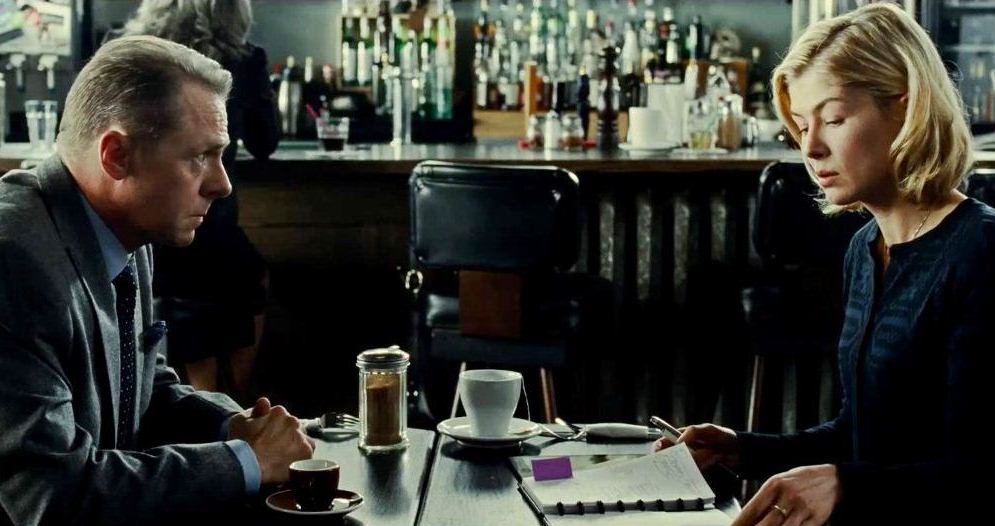
In the new film Hector and the Search for Happiness, Simon Pegg plays the title character, a psychologist with a tidy, uneventful existence. He shares his predictable and safe life with Clara (Rosamund Pike), an ad agency writer who creates names for pharmaceuticals. They chug along happily until one day Hector snaps and sets out on an archeological dig of sorts, to discover what happiness means to people.
“With this film,” says Pegg, “people will often flippantly say, ‘He lives with Rosamund Pike, he’s got a nice house…’ which so misses the point. You can have all that stuff. The point is we take the least sympathetic demographic on the face of this earth, the white upper middle class male and say, ‘He has a problem.’ It just goes to show that if he can be there and be unhappy then anybody can be unhappy.”
When asked if show biz success is a recipe for happiness both Pegg and Pike chime in.
“It’s a question I have been asked,” says Pike. “Fame and money, surely they are the ingredients to a happy life? The point is we keep sadly seeing that unless you are happy before you get those things it’s not a recipe for happiness.”
“Not to bring it up in a facile way,” says Pegg, “but Robin Williams’ death is an indication of that. I find for me I have to be happy in my real life, in the real world, and if I’m happy there I can be happy elsewhere and can enjoy this job.
“I’ve been desperately unhappy while working. I remember when I went to LA to do Mission Impossible III I wasn’t in a great place and I got there and I remember thinking to myself, ‘I’m in a film with Tom Cruise and yet I’m unhappy.’ It was an epiphany for me.“
“Obviously the idea of a successful career is that you look like a swan gliding and nobody sees the paddling duck feet,” says Pike, “but they’re definitely there. I think the message of the film is ‘You can’t really know happiness unless you are prepared to embrace life with everything it throws at you.’ The unhappiness too. When you go through something horrific in your life, loss or death or illness or whatever, people say this will make you stronger and you think, ‘Oh sod off,’ but of course it does. It makes you appreciate things in the future more and you do feel happier for having been through the bad times.”
If the Paranormal Activity movies curdle your blood and The Conjuring kept you up at night, perhaps A Haunted House 2 will be more your style. A humorous hybrid of horror hits, it stars Marlon Wayans and Jaime Pressly in a sequel to the popular (but critically lambasted) 2013 comedy.
According to IMDB in the new film Wayans has “exorcised the demons of his ex” and is trying to start his life anew with his girlfriend. Unfortunately his new house turns out to be haunted and, even worse, his back-from-the-dead ex has moved in across the street.
It’s all played for laughs and will likely not give audiences nightmares but it would be interesting to know how the makers of movies like Sinister, The Possession, and Insidious feel about having their movies made fun of.
Some filmmakers are flattered.
Night of the Living Dead icon George A. Romero enjoyed the zombie takeoff Shaun of the Dead so much he asked star Simon Pegg and director Edgar Wright to appear in Land of the Dead. The duo can be seen chained up in a 12-second cameo under a sign that reads Take Your Picture with a Zombie during the film’s carnival sequence.
But not everyone gets the joke.
Years ago Boris Karloff made it known he wasn’t very happy about a horror comedy. He was approached to play the Monster in Abbott and Costello Meet Frankenstein but declined because he felt the duo’s brand of slapstick would be an insult to horror movies. Nonetheless he did some promo for the film—there are publicity pictures of him buying tickets at the box office—and later appeared in Abbott and Costello Meet the Killer, Boris Karloff and Abbott and Costello Meet Dr. Jekyll and Mr. Hyde.
Another horror legend said yes to Meet Frankenstein but no to the comedy. The movie was the only other time Bela Lugosi played Dracula on the big screen and he played it straight.
“There is no burlesque for me,” he said. “All I have to do is frighten the boys, a perfectly appropriate activity. My trademark will be unblemished.”
Finally, the movie Young Frankenstein gave overdue credit to an old time movie studio technician. When Mel Brooks was prepping the film he discovered that Ken Strickfaden, the designer of the “mad scientist” electrical machinery in the Universal Frankenstein films, had all the equipment from the original movies stored in his garage. Strickfaden agreed to rent Mel the props and received a screen credit, which he hadn’t been given on the original films.
In Toby Young’s aptly named book How to Lose Friends and Alienate People, now a motion picture starring Shawn of the Dead’s Simon Pegg, he detailed how not to become a success in the cut throat world of New York magazine publishing. In 1995 English journalist Young accepted a job with Vanity Fair as a contributing editor. He may have envisioned himself to be the next Alistair Cooke, but from the second he stepped off the plane from London he was doomed to failure. His laddish stunts and seemingly bottomless aptitude for offending people made him an outsider in the oh-so-proper world of Conde Nast.
For example he broke every office sexual harassment rule by hiring a Strip-o-gram for a fellow employee, and to make matters worse he did it on that most politically correct day of days, Take Your Daughter to Work Day. For most of the time he worked at Vanity Fair he sat idle, collecting a large pay packet for doing very little work. He blew the biggest story he was assigned, interviewing actor Nathan Lane by asking him a series of inappropriate questions, culminating with a discussion about his sexual practises. Lane walked out of the interview, and Young’s career at VF was pretty much over. Perhaps his most pathetic move was to add the prefix “Hon” (short for “Honourable”) to his VISA in an attempt to impress New York women. The Sunday Times called the book “the longest self-depreciating joke since the complete works of Woody Allen.”
For legal reasons, I would imagine, many of the names have been changed—Vanity Fair editor Graydon Carter becomes Clayton Harding—and some of the details are different—Vanity Fair is now Sharp Magazine—from the famously sharp tongued memoir, but star Simon Pegg does manage to capture most of the “negative charisma” that Young describes himself as having in the book.
Comparisons to the best selling book end there, however. The basic storyline is the same and many of the incidents from the book are faithfully reproduced, but Young’s analysis of where everything went wrong, the thing that made the book a delight, has not translated. Instead we’re offered up a catalogue of his endless faux pas, many of which are quite funny, without much in the way of social commentary. Compared to the book it’s a rather empty exercise in slapstick and humiliation that plays up the romance between Pegg’s character and Kirsten Dunst at the expense of the book’s in-depth fish out of water story. Like the magazine he was fired from Young’s book is a mix of high-brow ideas presented with low brow appeal. The movie, however, tends to concentrate on the low brow.
The actors are well cast and fun to watch. Danny Huston is suitably oily as Lawrence Maddox, the unctuous editor of the magazine’s On the Town column; Jeff Bridges is effortless as the oddball publisher Harding; Dunst brings a frumpy appeal as the damaged love interest; Gillian Anderson is spot on as a manipulative publicist and Megan Fox ups the sex appeal of the character of starlet Sophie Maes, but this is Pegg’s movie.
As usual he is wonderfully watchable as the oafish Sidney Young (for some reason the author’s name was changed) and brings a great deal of charm to a character who should be unlovable in the extreme.
How to Lose Friends and Alienate People suffers for concentrating on the basic elements of the story—his oafish behaviour and the romance—sacrificing the juicy gossip and insight that made the book a best seller, but is saved by engaging performances from Pegg and Bridges and some funny, but cringe worthy moments that redefine social awkwardness.
Jerry Bruckheimer is the most successful movie producer on the planet. Nicknamed “Mr. Blockbuster” Bruckheimer is either regarded as a genius or a lowbrow hack, depending on your tolerance for rapid gunfire, slo-mo car crashes and scripts with the emotional depth of a lunch tray. Movies such as Bad Boys, The Rock and Con Air have made him very rich and while he busied himself circling the earth in his Gulfstream IV private jet, thinking up new and insidious ways to blow things up, a trio of British filmmakers came up with a film called Hot Fuzz that both pays tribute to, and takes the Mickey out of, the Bruckheimer oeuvre.
A couple of years ago actors Simon Pegg and Nick Frost, along with director Edgar Wright created Shawn of the Dead, a zombie movie that effectively mixed big laughs with buckets of gore. That movie became a giant cult hit, establishing them as purveyors of smart, funny pop culture satire. This time out they’ve made an unlikely buddy cop picture that takes a few minutes too long to take off, but pays big dividends in the third act.
Nicholas Angel (Simon Pegg) is a big city London cop with an impressive record. He lives and breathes the job, and in one year racks up an incredible 400 arrests. His efforts don’t go unnoticed. In fact, they attract too much notice forcing his supervisors to arrange to have him shipped off to a remote village because his gung-ho attitude is making them look like slackers. Transferred to the sleepy little township of Sandford he soon begins to suspect that the quiet town holds some dangerous secrets. Teamed with a bumbling partner (Nick Frost) he sets out to get to the bottom of a series of remarkable “accidents” that have claimed the lives of several notable citizens. The nefarious plot the feisty cop uncovers is part Wicker Man, part Bad Boys.
Director and co-writer Wright carefully combines the very English sensibility of a movie like Wicker Man, in which a small community is investigated by a strong-willed cop, with the pyrotechnics of an American action film. Using the Bruckheimer Rule which states that the movie will get bigger, louder and more violent as it nears its close, Wright begins with a character study that morphs into a full-on blood-soaked actioner by the end of the last reel.
Cleverly edited and smartly written—homages include a tip of the hat to Chinatown, the greatest crime script ever written, with, “Forget it, Angel. It’s Sandford” and a literal shot-by-shot recreation from Point Blank—the film could use some judicious editing in the early reels. Hot Fuzz has an interesting premise and some good jokes, but at 121 minutes it feels a bit labored.
To pass the time during the dull bits keep your eyes peeled for some unaccredited big time cameos. Sharp-eyed viewers will be able to spot Lord of the Rings director Peter Jackson as a homicidal Father Christmas, and Cate Blanchett as Angel’s masked CSI ex-girlfriend.
Hot Fuzz doesn’t succeed as brilliantly as Shawn of the Dead, but does an admirable job of mixing hilarity and havoc. I think even Bruckheimer would approve.
“Paul,” the new comedy from “Sean of the Dead” duo Simon Pegg and Nick Frost, is a something-for-everyone movie. Sci fi, check. Buddy comedy, chase scenes, fish-out-of-water and romance? Check, check, check and check.
Pegg and Frost play British sci fi nerds exploring “the less touristy side of the American Midwest.” Starting at nerd central, Comic Coin, they plan to RV it to every UFO landing site they can find—the Black Mailbox, Area 51—but their trip is sidelined when they come across an actual alien, Paul (voice of Seth Rogen), a foulmouthed ET on the lam. For sixty years after crash landing on earth he lived at an army base thinking he was a guest. When he realized he was a prisoner, he says, he made a run for it. Pursued by federal agents (Jason Bateman, Bill Hader and Joe Lo Truglio) and the angry father of a girl they accidentally kidnap (Kristen Wiig) they try and make it back to Paul’s mothership and his ride back to the safety of his own planet.
“Paul,” which was written by Pegg and Frost, lacks the laugh-out-loud-every-two-minute rhythm of their previous movies, “Sean of the Dead” and “Hot Fuzz,” but it has a lot of heart. Pegg and Frost have great chemistry—they’re kind of the Laurel and Hardy of geek culture—and are absolutely likeable in the leads. They are responsible for 90% of what makes “Paul” so agreeable.
The alien is amusing and way less of a frat boy character than the trailer would have you believe. They’ve also given him a cool backstory—he was the model for all big eyed pop culture extraterrestrials and consulted with Spielberg on the making of ET—and while Rogen’s voice work is OK and the computer face rather expressive, he’s not as much fun as Pegg and Frost. Ditto Wiig who is stuck with running gags involving Charles Darwin—born again Christians beware! You will not be pleased—and loads of creative swearing that never tickles the funny bone.
Despite its downsides—some misfired gags and a conventional story structure—“Paul” is satisfying not because of its homage to “Close Encounters of the Third Kind” or the excellent call-back to “Aliens” but because of the relationships and the bonds that form between the characters. I can’t help but think that “Paul” might have had more of a funny edge had “Sean of the Dead” and “Hot Fuzz” director Edgar Wright had been at the helm, but as it stands “Paul” is an enjoyable diversion.
The lovable loser has always been a staple in Hollywood films. In the early days Harold Lloyd and Max Davidson were nerdy characters the audience cared for despite their shortcomings. More recently Ben Stiller and Seth Rogen have kept the tradition of the terminally behind-the-eight ball character alive and kicking.
Rarely, however, has a loser been as hard to love as Dennis (Simon Pegg), an ambition-challenged Brit who leaves his beautiful, pregnant fiancée Libby (Thandie Newton) at the altar in the opening moments of Run Fatboy Run, a new comedy directed by David Schwimmer.
Ever since that fateful day Dennis, now working as a security guard at a London women’s wear shop, has rued his decision to flee from commitment and responsibility. Five years on his life hasn’t changed much. He still lives in a dumpy apartment, he’s still slightly overweight, still works a dead end job and still can’t pull his act together. The only thing he’s almost good at is being a father figure to his son, and even then he has more bad days than good.
The catalyst to change his life comes in the form of Whit (Hank Azaria) a good looking hedge-fund trader. He’s everything Dennis isn’t—slick, successful and disciplined. He seems too good to be true. Saint Whit even runs marathons for charity in his spare time.
As Whit becomes more enmeshed in Libby’s life Dennis is overcome by jealousy and becomes determined to beat Whit at his own game—marathon running—to win back Libby’s trust and affection. Of course, in his quest for Libby’s love he discovers his own sense of self worth and becomes a better person. Still a loser perhaps, but a more lovable one than the man we met in the film’s opening minutes.
Run Fatboy Run isn’t the most original story to come down the pike this year. Unlike the edgy offerings from past Simon Pegg (he both stars and co-wrote Run Fatboy Run) movies like Sean of the Dead and Hot Fuzz, it plays like a sitcom—although one with far fouler language than you’re likely to hear in prime time—which shouldn’t be too much of a surprise as it was directed by Schwimmer, best known as the actor who played Dr. Ross Geller on 238 episodes of Friends.
On the plus side though, it plays like a good sitcom. The romantic comedy storyline is predictable—otherwise it wouldn’t be a romantic comedy, but a romantic calamity—and the Rocky-esque training and marathon run ends pretty much as you would imagine, but you know that going in. The trick here is to make the predictable aspects of the story entertaining and Schwimmer and company do just that with a competent cast, lead by Pegg who can milk laughs out of almost any material and who plays Dennis as a real person and not just a beer-swilling caricature.
The whole film has a winning sweet-natured tone that smoothly weaves rom com conventions with slapstick and a good dose of sentimentality to create a whole that won’t win any awards for originality but has its heart in the right place.
“The World’s End” exists somewhere at the intersection of “Invasion of the Body Snatchers,” “Westworld,” “The Big Chill” and “Withnail and I,” but it’s not a geographical location. The new film from the makers of “Shaun of the Dead” and “Hot Fuzz” is about a state of arrested development, populated by a guy who never grew up, his friends who have and… robots.
Gary King (Simon Pegg) can pinpoint the best night of his life. Hours after graduating school he and four friends attempted the Golden Mile pub-crawl—one mile, twelve pubs—in the quiet British town of Newton Haven. It was an epic night for the teenager, filled with pints, pals and even a bit of illicit bathroom snogging, even if he fell three short of the final pub on the list, The World’s End.
In the twenty years since his life has been a flatline. “I’m the same old Gary,” he says, and that’s the problem. His old buddy Oliver (Martin Freeman) is a successful real estate agent, Peter (Eddie Marsan) sells luxury cars, Steven (Paddy Considine) started and sold a thriving business and former best friend Andrew (Nick Frost) is an attorney. Gary hits upon the idea of putting the band back together, so to speak, and relive the good old days. Or as he remembers them, “The camaraderie, the fights, the hangovers so fierce it feels like your head is full of ants.”
The pub-crawl becomes less about nostalgia and more about survival when the townsfolk of Newton Haven are revealed to be automatons enlisting new recruits for their cause. As the friends—now including Oliver’s sister Samantha (Rosamund Pike)—battle the mysterious creatures Gary remains focused. It’ll tale more than DNA thieving robots to stop him from completing his childhood dream.
Like the other films in the Three Flavours Cornetto trilogy—“Shaun of the Dead,” Hot Fuzz” and this movie—“The World’s End” is a memorable mix of characters and situation.
Once again Cornetto regulars Pegg and Frost are front and center, although playing against type. Pegg’s take on Gary has much more swagger than we’ve seen from him in the past. He’s a selfish motor mouth, concerned only with his redemption and the completion of the Golden Mile challenge. He’s a living embodiment of the dangers of living in the past but Pegg somehow makes him bearable and very funny. He spouts the complicated dialogue effortlessly, and check out the balancing act as he battles aliens and tries not to spill his pint.
Frost plays it straight for the most part, playing a straight-and-narrow attorney who (MILD SPOILER) goes off the rails when the alien takeover plot is unveiled. His deadpan delivery in the first half pays off with big scene stealing laughs in the second half when he lets loose.
“The World’s End” isn’t as consistently laugh-out-loud funny as “Shaun of the Dead” or as action-packed as “Hot Fuzz,” but its thematic core—the difficulty of growing up—is evident in every frame, making it the most mature of the Cornetto films.
Usually, on-screen E.T.s are presented as either nurturing, evolved beings from another planet, sent here to help mankind, or vicious world domination types, intent on colonizing or destroying Earth. But movies often encounter a third kind of movie alien, the goofy intergalactic visitor.
In this weekend’s Paul, nerd superstars Simon Pegg and Nick Frost play Brit sci-fi geeks on a pilgrimage to some of America’s UFO hot spots. Along the way they help Paul (voice of Seth Rogen), an irreverent alien with a taste for silly gags and Bob Dylan jokes, get back to his home planet. Think of it as E.T. for frat boys and you get the idea.
In the world the movie creates, the idea of a wisecracking alien makes perfect sense, but adding an E.T. doesn’t always fit so well. Take Meatballs Part 2, for instance. The addition of Meathead, a grey, rubber-skinned alien sent to Camp Sasquash to earn an Earth merit badge, hardly improves on the original Bill Murray classic.
The fun -loving aliens of Earth Girls Are Easy are put to better use. The movie’s plot is best summed up by manicurist Valerie (Geena Davis) as she enlists her friend Candy (Julie Brown) to give the aliens a makeover: “A UFO landed in my pool and they captured me but we made friends and I fed them Pop-Tarts and… we’ve got to cut their hair.”
Once shaved, the former red, blue and yellow-furred wookies look a lot like Jeff Goldblum, Jim Carrey and Damon Wayans and are ready to hit the L.A. clubs in search for love. They may be aliens, Candy says, “but they can still be dates!”
In Phil the Alien, Rob Stefaniuk plays a stranded space-shape-shifter who hides in plain sight on Earth as the singer of a Christian rock band. Best line? “I’m staying with a beaver,” says Phil, “down by the brook.”
One of the most memorable movie aliens is Mathesar, the haute-contre voiced Thermian leader played by Enrico Colantoni in Galaxy Quest. Learning everything he knows about Earth from television transmissions, he turns to the cast of a cancelled sci fi show to help save his planet.
Favourite scene? When one of the actors, Gwen DeMarco (Sigourney Weaver), explains that TV shows are not “historical documents” she says, “Surely, you don’t think Gilligan’s Island is a…”
“Those poor people,” Mathesar interrupts, moaning in despair.
 By Richard Crouse – Metro Canada