“Homefront,” a new actioner starring Jason Statham and James Franco emoting from a script written by Sylvester Stallone, is the kind of movie that probably plays best on VHS. It feels like an old-school action flick, one that might have starred Stallone in the early nineties, that might be best seen through a haze of snowy grain.
But the real advantage to watching this on video would be the chance to fast forward through all the slow bits.
Statham plays Phil Broker, a former undercover cop who left law-and-order behind after a sting went bad and a biker drug lord’s son was executed. Now he leads a quiet life with his ten-year-old daughter Maddy (Izabela Vidovic) in Rayville, Louisiana, a backwoods town one resident ominously describes as, “a bit like Appalachia… feuds can happen here.”
Sure enough Broker and his daughter become the talk of the town when Maddy punches a bully at recess. What should have been a schoolyard scrap escalates when the bully’s mom (an emaciated Kate Bosworth) asks her meth-dealing brother Gator (Franco) to pay Broker a visit and even the score.
Before you can say Hatfields and McCoys, Gator is causing trouble. He discovers the truth about Broker’s past and in addition to fueling some good old fashioned feudin’ he hatches a plan with his “meth whore” girlfriend Sheryl (Winona Ryder) to hand over Broker to the bikers he double crossed in return for a meth distribution deal.
It sounds exciting—it hits all the b-movie b’s, bikers, babes and bullies—but Statham is at his best when he’s busting heads and the movie provides relatively little of that. Sure he nails a guy to a post with a knife and pushes another dude’s head through a car window but he spends most of the movie in family guy mode.
He cares for his daughter, her stuffed bunny and cat Luther, and the movie really wants us to know it but endless scenes of Broker mooning over his daughter grind the story to a halt. Too bad there’s no fast forward button at the theatre.
In other words, I liked it when Statham was punching people. I liked it less when he wasn’t.
“Escape Plan” is the kind of movie you used to rent on DVD back when there were video rental stores on every corner. It wouldn’t have been your first, second or maybe third. It’s the kind of movie you chose when everything you actually wanted to see was gone. “This doesn’t look too bad,” you’d say to yourself, warily holding the case in your hand.
Combine low expectations with a couple of beers and maybe a fast forward button and “Escape Plan” is passable. But take any of those elements away and add in the price of a big screen ticket and the movie becomes way less passable.
Sylvester Stallone is Ray Breslin, a lawyer-turned-escape artist. He’s the Houdini of the penal system, a man who makes a lot of money as structural-security authority.
In other words he escapes prisons for a living.
He’s broken out of fourteen maximum-security jails but when he takes a job at The Tomb, a privately run prison where the worst-of-the-worst—people who need to be “disappeared”—are warehoused everything goes wrong. The deal changes and it looks like he might live out the rest of his years behind bars. Up against the evil Warden Hobbs (Jim Caviezel) he schemes with another inmate Rottmayer (Arnold Schwarzenegger) to “Papillon” their way out.
This is the kind of movie that used to go straight to DVD. The real question here is how “Escape Plan” escaped that fate and made it to the big screen.
On the upside it has a pretty good villain in Caviezel who is the nastiest warden since “Caged Heat’s” McQueen. There’s a twist I did not see coming and hearing Arnold say, “You punch like a vegetarian,” is always welcome, but I always hoped when Arnold said, “I’ll be back,” it would be in a good movie.
On the downside, and it is, admittedly, a lopsided pro and con list, there is dialogue that sounds like it was run through the Cliché-O-Matic™–not the new, updated iOS 7 version, but an older analogue model—to a couple of lame attempts at creating new catchphrases to the sight of two aging action stars trying to relive the glory years.
“Escape Plan” is further proof that the Sly and Arnie show only really works if the work “Expendable” is in the title.
When you think of the movies of Arnold Schwarzenegger or Sylvester Stallone gut busting action comes to mind. The names Steve Martin and Adam Sandler are forever connected to comedy while Daniel Day Lewis is synonymous with serious drama. Meg Ryan? She’ll always be a romantic comedy star just as the mere mention of Robert Eglund’s can name send a chill down the spine.
But what about Tom Hanks? Hanks is a rarity among a-listers. He’s an actor who has avoided stereotyping by pasting together a resume that includes every almost genre of film.
This weekend he stars in Captain Phillips, a drama based on the true story of the 2009 hijacking of the MV Maersk Alabama by Somali pirates.
It’s a heroic role—in real life President Obama said Capt. Richard Phillips’ courage “is a model for all Americans.”—but it’s a far cry from his last movie, Cloud Atlas, which saw him play three characters, one of which tossed a critic out of a skyscraper window.
His varied IMDB listing includes everything from comedies like Splash (“What you looking at? You never seen a guy who slept with a fish before?”) to Academy Award winning dramas like Philadelphia, where he played a gay lawyer with AIDS suing his firm for discrimination and Forrest Gump.
In the kid’s classic Toy Story (and its subsequent sequels) he’s Woody, a stuffed pull-string cowboy doll. Director John Lasseter says he wanted Hanks to play the character because of his “ability to take emotions and make them appealing.”
Much darker is Road to Perdition, the 2002 Sam Mendes film that cast Hanks as Michael Sullivan, Sr, an ace hitman who must protect his son from a mob assassin. “I just got this guy,” says Hanks. “If you’re a man, and you’ve got offspring… emotionally, it’s devastating.”
Different still is Nothing in Common, a dramedy that saw Hanks play a successful advertising executive trying to cope with his parents’ (Jackie Gleason and Eva Marie Saint) break up. “[It] has a bit of a split personality,” Hanks said, “because we’re trying to be very funny in the same movie in which we’re trying to be very touching.”
Hanks says, “I’m not looking for any particular kind of story,” and his varied approach to his work hasn’t hurt him one bit. Recently he was named America’s “best-liked movie star,” in a poll by Public Policy Polling.
“The Expendables 2” has Cold War undertones to go along with a cast that found fame during that time. Aging action heroes Sylvester Stallone, Dolph Lundgren, Chuck Norris, Jean-Claude Van Damme, Bruce Willis and Arnold Schwarzenegger act out a shoot ‘em up with so much blood and guts it would make James Bond positively red with envy.
I could tell you the plot of “The Expendables 2,” but this movie isn’t about the story. It’s a revenge flick about a team of mercenaries who will take on any mission, no matter dangerous, for money. Imagine what they’ll do for payback! In other words: “Track ‘em. Find ‘em. Kill ‘em.”
The old guys are mixed-and-matched with (slightly younger and more limber) film fighters Jason Statham, Jet Li, Randy Couture, Terry Crews and Liam Hemsworth.
There’s enough grizzled faces on display here to make you think you’re watching at Mount Rushmore. The difference is, these faces speak. They say things like, “Rest in pieces,” after they’ve shredded a bad guy.
Most of the dialogue sounds as though it was run through the Action-Movie-Cliché-O-Matic™. The ever-popular “Houston we have a problem,” line makes an appearance, even though no one in the cast is named Houston and the film isn’t set in Texas.
More successful are some of the meta-jokes about clichés and the surreal cameo by Chuck Norris.
Mostly though the dialogue gets in the way of the big action scenes, which, let’s face it, are the real reason to see a movie like this. When the actors are speaking instead of shooting your mind wanders. “Why does Stallone have a Ming the Merciless moustache?” you may wonder. “How much did they set aside in the budget for arthritis medicine?”
But these are nit-picky points. How do you review a movie like “The Expendables 2”? I can say if you have a soft spot for 80s action, you’ll probably like it. If not, go see “Hope Springs” instead. The best review for the movie actually appears in the film. At one point Bruce Willis says, “A nice touch. A little extreme, but nice.” My thoughts exactly.
“The Expendables,” the new film starring every action star known to man, including Sylvester Stallone, Jason Statham and Arnold Schwarzenegger (and that’s just the Ss!), is a nostalgia fest celebrating those cinematic days of yore when gangs of mercenaries led by action heroes like Dolph Lundgren could bring down governments and spread the American way of life armed only with an arsenal of guns, knives, grenades and one liners. That the heyday of this kind of movie, and most of the actors in it, was twenty-five years ago is not going to prevent “The Expendables” from kicking butt and lots of it.
In this blood and testosterone splattered story Stallone leads a group of freelance soldiers—knife tosser Lee Christmas (Jason Statham) hand-to-hand expert Ying Yang (Jet Li), sniper Gunner (Dolph Lundgren), big gun toter Terry Crews and MMA superstar Randy Couture—whose motto is “if the money’s right we don’t care where the job is.” When they take a job to bring down a dictator (David Zayas who plays Angel on “Dexter”) and American drug lord (Eric Roberts, whose sister Julia has a very different kind of movie opening on the same day as this one) on the South American Isle of Vilena, however, they may have finally found one hotspot worse than Bosnia, Sierra Leone and all the other hellish places they’ve fought for pay, combined. The only thing than can get them to go back there is—you guessed it—a woman. Cue the explosions.
Not that there aren’t some retina scorching action scenes. Stallone (who also directed) uses each of the individual talents of his actors well—it’s always a pleasure to see Jet Li in action—and several things blow up real good, but when the movie tries to go deep it stumbles. When Mickey Rourke, who plays Tool, a former soldier of fortune who now sets up their engagements—think Charlie on “Charlie’s Angels”—drones on about trying to “save what was left of my soul” it grinds the movie to a near halt.
It’s been twenty years since Sylvester Stallone last played Jonathon James Rambo, a rogue warrior so tough he combed his hair with barbed wire. In just three films this guy made those other 80s action icons, Bruce and Arnold, look like another 80s icon—Pee Wee Herman.
While other 80s stars like Frogger and the Where’s the Beef lady are now long distant nostalgic memories Rambo, true to character, refused to disappear quietly.
Despite there being no new Rambo movies for two decades, the name has been in almost continuous use both as a noun and a verb. The character has been parodied on film in Hot Shots! Part Deux, paid tribute to in a video game called Ikari Warriors, name checked in the Nicolas Cage film Lord of War (a character wants to buy “the gun of Rambo,” referring to the M60 and Cage asks “Part one, two, or three?”) and appears in the alternate history novel Back in the USSA by Eugene Byrne and Kim Newman.
As a verb the phrase “Going Rambo” has come to refer to anyone who takes on a fight with little or no regard for their own personal safety.
Pop culture has had a hard time letting go of Rambo, and so it seems, has Sylvester Stallone, who at the age of 61 has donned Rambo’s trademark bandana one more time to bring justice to a world gone mad.
John J. Rambo (Stallone) now lives in northern Thailand, retired from the army, eking out a living running a longboat on the Salween River and catching poisonous snakes to sell. He leads a solitary life, leaving the violence of his past where it belongs—in his past.
His quiet life is interrupted when a group of Christian aid workers led by Sarah (Dexter’s Julie Benz) and Michael Bernett (Paul Schulze) recruit him as a guide to deliver medical supplies to the Karen tribe on the nearby Thai-Burma (Myanmar) border where the world’s longest-running civil war, the Burmese-Karen conflict, has been raging for 60 years.
“Burma’s a war zone. Its suicide,” Rambo tells the missionary, urging the group not to go.
“More like genocide.” Michael says gravely.
Reluctantly Rambo drops them in the war torn country and returns to Thailand, but when they fail to return he is talked into taking a group of mercenaries back into the border region to find the lost missionaries. Rambo is conflicted about the mission, as his new life style requires he have the utmost respect for human life—unless, of course, it gets in his way.
If you like the Rambo of old, you’ll like this new one because nothing much has changed in the years since we saw him last. In fact, other than a few wrinkles on Sly’s face, it’s as though the movie has magically teleported itself to our screens from the mid-80s. He’s still a rootin’, tootin’ killing machine who cuts, dices, kicks, spindles, mutilates, stabs, shoots, punctures, chokes, blows up, punches, shreds, head butts, pummels, thumps, harpoons, jabs, machine guns, bashes, runs through and generally does damage to a whole lot of bad guys.
The body count in Rambo (apparently one person is killed every 2.59 minutes) easily eclipses the 108 deaths in Rambo III, which earned it a Guinness Book of World Records title for Most Violent Movie Ever. It’s so high I would guess MIT professors had to be called in to create a new number to represent the carnage left in Rambo’s wake.
So, unless you date’s name is Rambina, this is most definitely not a date movie. Blood and guts splatter the screen and stoic Stallone delivers lines like, “Live for nothing, or die for something,” with his usual heavy-lidded comic book gravitas. It’s not exactly cuddly, but that’s what movies like 27 Dresses and the like are for.
Rambo isn’t for everyone, but its monosyllabic charm should appeal to anyone who likes straight up genre pictures with all the subtlety of a punch to the head.
Robert Rodriguez is putting his extremely profitable kid’s franchise to bed with a 3-D story that is, unfortunately not as multi-dimensional as the name would imply. Three years ago the original Spy Kids seemed like a breath of fresh air, it was a colourful, exuberant affair that burst with inventiveness and humour. The inevitable sequel, 2001’s The Island of Lost Dreams, proved that there is some merit in the theory of diminishing returns, while Game Over confirms that additional incremental input will produce a declining incremental amount of output.
In other words, most sequels suck.
In this instalment older sister Carmen (Alex Vega) is being held hostage in an elaborate virtual reality videogame called Game Over, run by the evil Toymaker (Sylvester Stallone). Brother Juni, (Daryl Sabara) who has retired from the spy business to concentrate on his career as a private eye must rescue his sister and shut down the game. Once inside the cyberspace monolith he loses his heart to a brave young girl (played by Emily Osment, sister of the Oscar nominated Haley Joel), races giant motorbikes and gives the viewer a headache watching all the swirling action through flimsy red and green 3-D glasses.
Rodriguez may have based the character of the Toymaker on himself. Like the evil genius in the movie, Rodriguez appears to be lost in his own creation, too fascinated by the 3-D technology to concentrate on giving the movie any kind of plot. What little story there is simply kick-starts the action, placing Juni in the game, and thus is an excuse to rev up the special effects. Turned loose in cyberspace the film careens through forty mind-numbing minutes of Super Mario Brothers quality graphics that flip and fly through the air, and even though things appear to literally jump off the screen, Spy Kids 3-D is flat.
Spy Kids 3-D has everything the first two instalments didn’t have from cardboard characters, to headache inducing special effects all the way down to bland dialogue.
The film is packed with several “don’t blink or you’ll miss ‘em” celebrity cameos. Rodriguez pal George Clooney provides one of the film’s few legitimate laughs (Spoiler Warning!) with his subtle Sylvester Stallone impression, while Cheech Marin, Steve Buscemi, Elijah Wood, Bill Paxton and Salma Hayek check in, but aren’t given much to do. Only Ricardo Montalban as the wheelchair bound grandfather seems to relish his role. Once inside the game he hams it up, trading in his chair for an animated metal superhero costume. He’s entertaining to watch because he seems to be having so much fun with the silly material. He even sneaks in a joke about “fine Corinthian leather.” It’s a line that the kids won’t get, but anyone over the age of thirty will recognize from his years as the spokesperson for Chrysler.
Montalban brings some joyfulness to the movie, and so does Stallone, it’s just a different kind of joy. It’s the kind of mean-spirited delight that comes from watching a formerly popular actor completely embarrass himself onscreen. Displaying an emotional depth that ranges from Rocky to Rambo, Stallone plays the evil Toymaker and three of his alter-egos, a nerdy scientist, a burn-out hippie and a war mongering general. The last time I heard such “hilarious” accents I was at my nine-year-old nephew’s school play.
Once Rodriguez moves the action out of the videogame the film takes on a warmer, more familiar tone, but it is too little too late. One hopes that the movie’s name is prophetic, and it really is game over for the Spy Kids franchise.
New Orleans is one of the great cities of the world. The vibrant, balmy beauty of the town gave birth to jazz, zydeco and some of the best food this side of Emeril Lagasse’s crock pot.
It’s also the location of many movies, earning the nickname Hollywood South in reference to the many films that have been shot there in recent years.
This weekend the new Sylvester Stallone Y-chromosome thriller Bullet to the Head takes place in the gritty underbelly of post-Katrina New Orleans. As they say in NOLA it lets “the bonne temps roulez” with some spectacular Crescent City scenery, good zydeco party music all washed down with a healthy shot of Bulleit bourbon.
Many recent movies have used the city as a backdrop, including Django Unchained, Looper, Killing them Softly, Killer Joe and Beasts of the Southern Wild.
Tennessee Williams loved the “Big Easy” so much he once said, “America has only three cities: New York, San Francisco and New Orleans. Everywhere else is Cleveland.” Enamored with the place, he set several of his plays there, most famously A Streetcar Named Desire which contains one of the most famous lines in movie history.
As played by Marlon Brando, Stanley Kowalski’s barbaric yell of “Stella!!” was voted one of the best movie quotes by the American Film Institute.
Streetcar’s director, Elia Kazan also set Panic in the Streets, the story of a doctor and a policeman who have just two days to find a killer infected with a highly contagious form of bubonic plague, in 1950s New Orleans. It’s dirty, dangerous, and claustrophobic — the perfect setting for a film noir.
Shot on location in New Orleans, it’s as though the freewheeling attitude of the city loosened Kazan up a bit. “I went wild,” he said. “It was a carny atmosphere. In one sequence, for extras we emptied a whorehouse of its girls; that was a jolly day. Living irregularly, I was in heaven.”
One movie to take advantage of the city’s connection to the occult—NOLA was, after all, the home of Voodoo priestess Marie Laveau—was Angel Heart. Mickey Rourke is Harry Angel, a New York City detective, hired by a mysterious man named Louis Cyphre (Robert De Niro). The role of Louis Cyphre (say it fast to hear the homophone) was originally offered to Marlon Brando who turned it down.
With a name like Bullet to the Head you know the new Sylvester Stallone movie isn’t a romantic comedy. Although he paraphrases the most famous rom com line of all time, “You had be at BLEEP BLEEP!” the movie is nothing but an ode to testosterone.
Set in the gritty underbelly of post-Katrina New Orleans, the story concerns Jimmy Bobo (Stallone), a career criminal and hired gunman. He’s right out of Central Casting, a tough guy who has his own set of rules—he never kills women or children. “That’s how you stay in the game,” he says, “and in this one, the game got rough.”
Very rough. After one gruesome hit job Jimmy And his partner Louis Blanchard (Jon Seda) relax at a bar—of course Sly drinks Bullet bourbon–only to be attacked by a hired goon. Louis is killed but Jimmy escapes, and is forced to do the last thing he ever though he’d do; team with a cop (Sung Kang) to find why he was double-crossed and his partner was murdered.
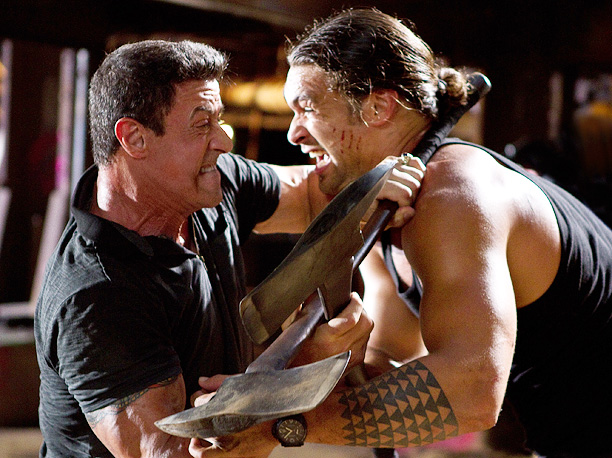
Directed by veteran Walter Hill and shot in Mano-A-Mano-Vision, this unlikely buddy movie wears its Y chromosome proudly on its sleeve. From the Rambo homage—head slowly peering out of the water—to the axe fight (that’s right, I said they fight with axes) this is the true definition of an anti-date night movie.
Film noir style, the movie begins at the end and then happens in flashback, complete with loads of punching, disemboweling, gratuitous nudity and bullets to the head along the way. If that appeals to you, so will the movie.
But know that it’s also a clunky affair, with no realistic point of view or character development or any of those other fancy-dancy things taught in film school. It’s simply a framework for the action scenes, and as such, works pretty well.
These movies have their own twisted morality—for the most part the right people get the bullets to the head–but the hired assassin, who delivers most of said bullets, because he’s played by Stallone, gets to be the hero. If there was more to him than muscles, guts and glory it would be tempting to call him an anti-hero, a man who lives by his own honorable code of ethics, but that would be giving too much credit to the character. This guy gets away with what he gets away with simply because Stallone is the biggest star in the movie. That makes sense in Hollywood, but it isn’t good storytelling.
Couple that with “hilarious” race baiting dialogue between Stallone and the Asian cop Taylor Kwan—”Nice going Oddjob,” or Jimmy’s habit of calling Kwan Confucius—which seems like a throwback to an earlier, less enlightened time and you have a movie with the subtlety of a kick to the face.